Water

According to Welthungerhilfe, the global consumption of water has increased almost tenfold in the past 100 years. Today, 31 countries have permanent water shortages, and this number could rise to 50 countries with some three billion inhabitants by the year 2025. Agriculture accounts for about two thirds of total global water use, while the industry uses another twenty percent, and households, ten percent. In contrast, industrial production in Germany accounts for over eighty percent of water consumption.

ALTANA consistently records its consumption of drinking water, surface water, and ground water. Overall, the Group not only reduced its use of drinking water in absolute terms from 770,000 m3 in 2007 to 596,000 m3 in 2010, but also in terms of the produced volume. In 2010, our drinking water consumption was 1.2 m3 / t (equivalent of 1,200 liters / ton). Our goal is to reduce our drinking water needs by five percent from 2007 to 2012. In 2010, approximately 650,000 m3 of groundwater and surface water were consumed, mostly for cooling. This water is either returned without contamination (once-through cooling) or it evaporates (cooling circuit with cooling towers).

Saving water in spite of high availability

ECKART Pigments in Finland is by far the largest water consumer in the Group and used as much as 383,000 m3 in 2007.

Thanks to optimized processes, this demand was decreased to 287,000 m3 by 2010. In terms of the produced volume, consumption therefore was reduced from 255 to 216 m3 / t. In light of the ample water supply in Finland, this high consumption continues to be acceptable.

ALTANA consistently records its consumption of drinking water, surface water, and ground water. Overall, the Group not only reduced its use of drinking water in absolute terms from 770,000 m3 in 2007 to 596,000 m3 in 2010, but also in terms of the produced volume. In 2010, our drinking water consumption was 1.2 m3 / t (equivalent of 1,200 liters / ton). Our goal is to reduce our drinking water needs by five percent from 2007 to 2012. In 2010, approximately 650,000 m3 of groundwater and surface water were consumed, mostly for cooling. This water is either returned without contamination (once-through cooling) or it evaporates (cooling circuit with cooling towers).

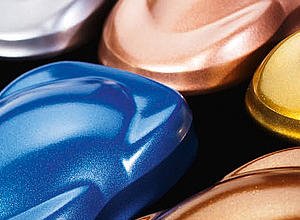
However, ECKART plans to further reduce water consumption with the development of new effect pigments such as Mirage and Luxan (see page 20) in the coming years. The installation of a closed cooling circuit also achieved water savings at ACTEGA Rhenania (from 5,750 to 2,390 m3 or from 0.5 to 0.19 m3 / t) and at ACTEGA Artística (from 1,020 to 662 m3 or from 0.235 to 0.155 m3 / t) over three years. This is particularly important for ACTEGA Artística, which is located in Spain, where water is scarce. The same applies in Italy, where the drinking water consumption at ELANTAS Deatech in Ascoli was reduced from 9,600 to 2,100 m3 or from 0.26 to 0.06 m3 / t with a new water treatment system.

Water for climate protection

The total water consumption within our Group does not include the water volume of 25,000 m3 we use as solvent, since this represents an environmentally sound alternative to fossil fuel-based solvents (see page 38). The U.S. has the highest per-capita consumption of coatings with about 10 liters per year. Assuming that coatings consist of 50 percent water, this would amount to 5 liters a year. The following comparison highlights the comparatively low volume of this use: The per-capita consumption of drinking water in Germany is approximately 47,000 liters a year.